Outcome Proof
PageSpeed results you can verify
Field Core Web Vitals and Lighthouse lab scores from bestsummercourses.com. Re-run any report at pagespeed.web.dev.
Desktop · field + lab
Jul 22, 2026 · PageSpeed Insights desktop
Core Web Vitals passed
- LCP 2.3 s
- INP 110 ms
- CLS 0.05
- FCP 2.2 s
- TTFB 0.7 s
Screenshots
Performance snapshot

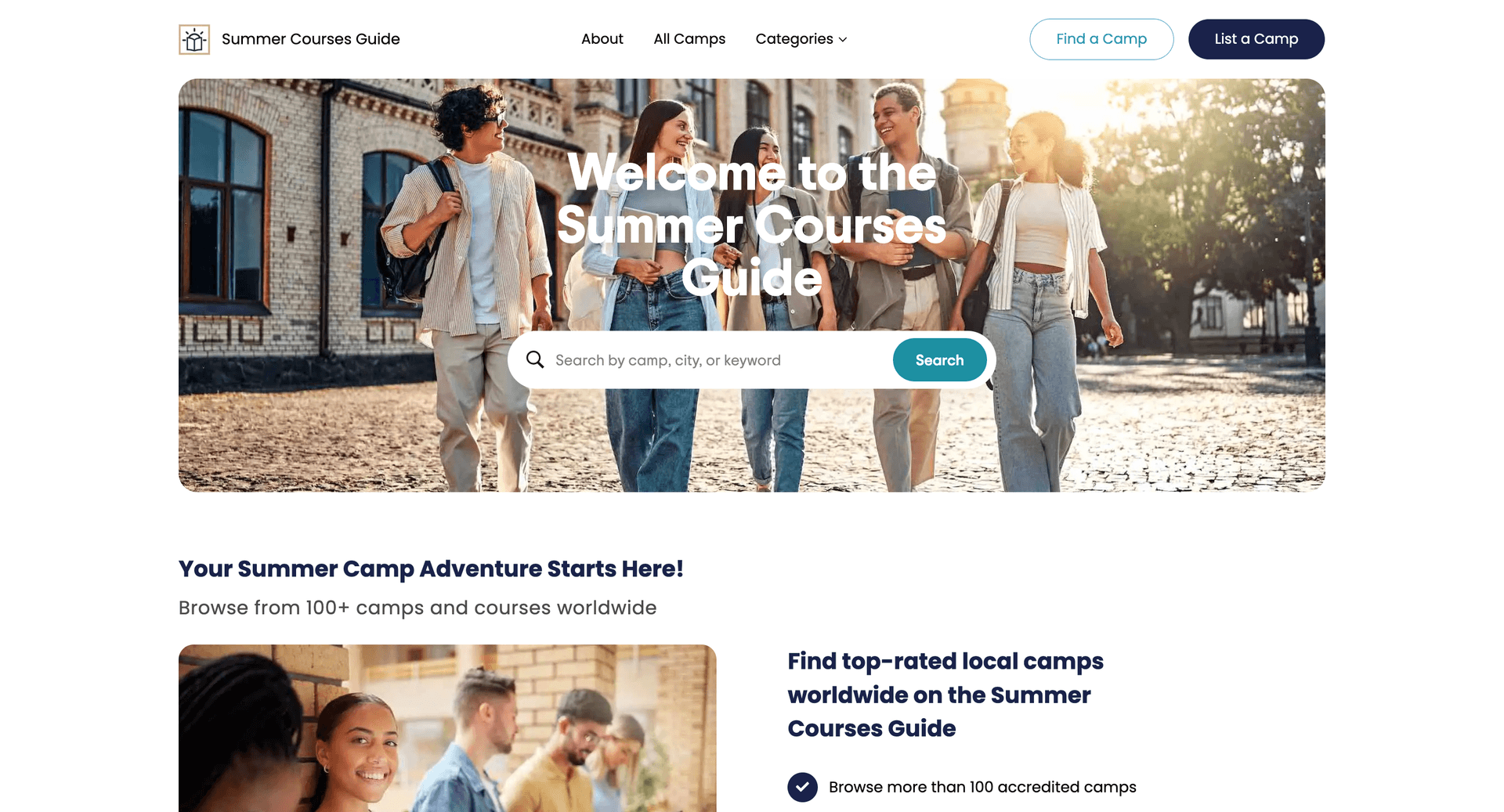
A global summer-camp directory built for search — The Best Summer Courses Guide is an independent platform helping students, parents, and educators discover summer schools, pre-university programs, and language camps across the UK, Europe, the USA, and beyond. We delivered it as a fast, filterable directory designed to rank in a competitive education niche.
The challenge: Families need to compare 100+ accredited camps across dozens of subjects — from Artificial Intelligence to Zoology — and 15+ categories including Academic, Adventure & Outdoors, Language Immersion, Oxford & Cambridge, Swiss International Camps, and UK Boarding Schools. That demands clean information architecture, faceted search, and page structure a crawler can actually understand.
Directory architecture that scales: Camps are organised by age, category, destination, and subject, with curated collections ("Best UK University Summer Schools", "Best Ivy League Summer Schools", "Top Summer Camps in Europe") that map directly to how families search. Every collection is a crawlable, indexable landing page — not a JavaScript-only filter state.
Built as a two-sided platform: Free browsing for families, with Free, Plus, and Pro listing plans for camp providers, editorial review of every listing, verified reviews from real attendees, and a provider dashboard for keeping course dates, fees, and program details current.
Data and content architecture: PostgreSQL is the primary application database, while Airtable supports operational data management and structured editorial workflows. The blog remains easy for content teams to manage in WordPress, with posts delivered to the Next.js front end through the WordPress API. This separates application data, operational management, and long-form publishing without forcing one system to do every job.
Key features: Faceted camp search (age, category, destination), 45+ subject taxonomies, curated top-collection pages, provider listing tiers, verified reviews, PostgreSQL-backed application data, Airtable data management, and a WordPress-powered blog.
Measured results (PageSpeed Insights, bestsummercourses.com):
- Desktop (Jul 22, 2026): Core Web Vitals Passed — LCP 2.3s, INP 110ms, CLS 0.05, FCP 2.2s, TTFB 0.7s; Lighthouse lab scores 98 Performance, 100 SEO
Screenshots in the gallery above match reports you can re-run at pagespeed.web.dev.
Why this stack: Directory sites live or die on crawlability, data quality, and speed. Next.js + React provide the application and presentation layer; PostgreSQL provides durable relational storage; Airtable makes operational data easier to manage; and the WordPress API gives editors a familiar publishing workflow for the blog. Same headless pattern as our Oxbridge Summer Courses Guide build.
Planning a directory, marketplace, or content platform? Migration service · Book a consultation from DevCritters.